

Stanley B&D IOT partner
Platform
Stanley Black & Decker, a global leader in construction and home improvement tools, partnered with moblers to develop a series of advanced IoT solutions that combine physical tools with smart digital control.
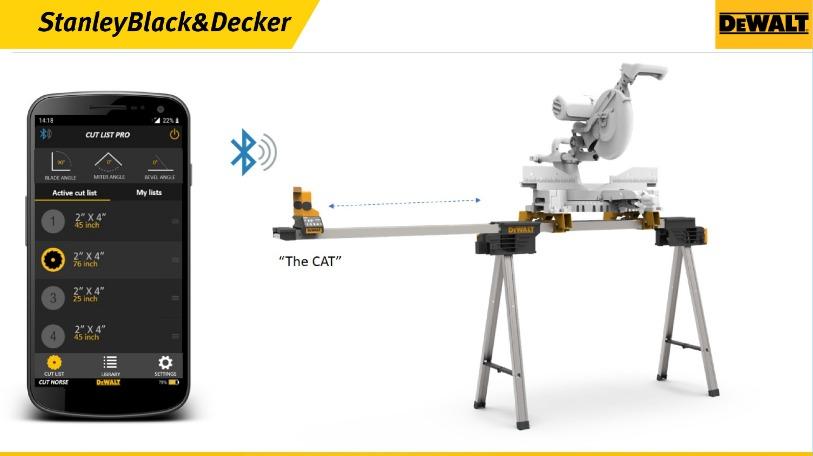
In the first phase, moblers built a dedicated mobile app to control the SBAD CUT device. Users can enter measurements manually or by voice, send them to the cutting tool, retain cut history, and define reusable presets.
In the second phase, moblers designed and delivered a functional smart measuring-tool prototype with custom electronics and enclosure design. The device connects to a laser or tape measure, supports direct measurement or voice/manual input through the app, stores measurements locally, and can send a selected measurement to the CUT or a compatible cutting tool.
Services
Connected CUT application
Manual and voice dimension input, reusable presets, cut history, and command transfer to the SBAD CUT.
Smart measuring prototype
Custom electronics and enclosure for measurement capture, local storage, and one-tap transfer.
Mobile, embedded, and hardware integration
A connected workflow spanning measuring, user input, stored measurements, and cutting-tool control.
The challenge
moblers solved several technical and operational challenges, including:
Voice-driven measurement input: Interpreting spoken dimensions for a professional-tool workflow.
Field-oriented hardware design: Developing custom electronics and an enclosure for construction-site use.
Connected tool workflow: Integrating measuring, input, storage, and cutting phases.
The solution
By combining mobile UX, hardware engineering, and embedded systems, moblers delivered:
- Voice and manual measurement input.
- Direct measurement from the prototype.
- One-tap transfer of a selected measurement to the cutting tool.
- Measurement/cut history and reusable presets.
- A functional hardware prototype ready for testing and scaling.
Evidence boundary
The public project record and a moblers blog caption confirm the two-phase scope above: the SBAD CUT application first, followed by related smart measuring hardware. They confirm custom electronics and enclosure design, local measurement storage, voice/manual input, cut history, presets, and transfer of measurements or commands to a compatible cutting tool.
The public record does not identify the radio technology, protocol stack, MCU/SoC, sensor models, electrical interfaces, PCB stack-up, battery, antenna, firmware platform, speech provider, security controls, certification status, quantitative test results, prototype quantities, current pilot status, or production roadmap. Those details are therefore not inferred here.
“Functional,” “field-oriented,” and “ready for testing and scaling” describe the published prototype status. They do not mean that production qualification, regulatory certification, ruggedization targets, or field-validation thresholds were completed.
Connectivity and data transmission
Confirmed logical links
- Measuring tool → prototype: the prototype connects to a laser or tape measure and supports direct measurement capture.
- Mobile app → CUT: voice/manual dimensions can be sent from the application to the SBAD CUT.
- Prototype/app → compatible cutting tool: stored or selected measurements can be transferred on demand.
- Offline behavior: measurements are described as stored locally before on-demand transfer.
Not publicly disclosed
- Wireless and wired transports: Bluetooth LE, Bluetooth Classic, Wi‑Fi, USB, UART/serial, proprietary RF, or another link.
- Protocols and versions: BLE GATT profiles, TCP/IP, MQTT, custom serial framing, API/message schema, acknowledgements, retries, and reconnection behavior.
- Pairing, authorization, authentication, and link encryption.
- Typical range, throughput, connection time, and command latency.
- The exact compatibility contract for third-party cutting tools.
- Firmware update channel and whether OTA is supported.
The word “connected” on this page describes the delivered end-to-end behavior; it should not be read as confirmation of Bluetooth, Wi‑Fi, or any named protocol.
Hardware architecture and prototype deliverables
 Laser or tape measure
 (model/interface not public)
           │ measurement input
           ▼
 ┌──────── smart measuring prototype ────────┐
 │ custom electronics / controller           │
 │ local measurement storage                 │
 │ button / user I/O                         │
 │ power subsystem                           │
 │ enclosure                                 │
 └───────────┬──────────────────────┬─────────┘
             │ link not public      │ transfer link not public
             ▼                      ▼
       Mobile application      SBAD CUT / compatible tool
       voice/manual input      receives selected dimension
       history and presets
This is a functional block diagram, not a schematic or confirmed component architecture.
Verified prototype work
- Custom electronics for a smart measuring-tool prototype.
- Custom enclosure design.
- Integration with a laser or tape measure.
- Direct measurement, local storage, and transfer to the CUT or a compatible tool.
- A functional prototype described as ready for testing and scaling.
Component and manufacturing details not publicly disclosed
- MCU/SoC make, model, clock, memory, firmware language, and OS/RTOS.
- Radio module/chipset, antenna design/placement, and RF front end.
- Laser/tape interface, sensor/transducer models, ADC resolution, microphone, IMU, and other sensing hardware.
- Battery chemistry/capacity, charging method, runtime, PMIC, and power budget.
- Connector types, GPIO/serial/analog interfaces, controls, and indicators.
- PCB dimensions, layer count, stack-up, BOM, suppliers, fixtures, and production constraints.
- Enclosure CAD format, material, fabrication process, finish, mounting, and tooling.
- IP target, sealing, drop requirement, temperature/humidity range, vibration/shock results, and EMC/EMI mitigation.
- Handoff artifacts and quantities (assembled units, Gerbers, firmware binaries, test fixtures, assembly instructions): not itemized publicly.
Performance and validation
No objective validation dataset or measurement period is published. Accordingly, the page does not assign numbers to these properties:
- Speech recognition: accuracy/WER, vocabulary, language, dataset size, microphone placement, and quiet/noisy test conditions are not publicly disclosed.
- Measurement quality: precision, absolute accuracy, range, repeatability, ADC resolution, calibration method, and test equipment are not publicly disclosed.
- Latency: median, p95, and worst-case voice-to-record or command-to-tool-action latency are not publicly disclosed.
- Wireless performance: packet loss, reconnection rate, operating range, and throughput are not publicly disclosed.
- Reliability: MTBF, prototype/field failure rate, uptime, environmental limits, and failure modes are not publicly disclosed.
- Power: measured runtime, charge time, and cycle life are not publicly disclosed.
- User/field testing: participant count, sites, duration, task-success rate, acceptance criteria, and findings are not publicly disclosed.
- Data: bytes per measurement, local capacity, retention limit, and synchronization throughput are not publicly disclosed.
The published phrase “voice recognition for dimensions” confirms the feature, not a specific accuracy percentage. “Ready for testing and scaling” confirms prototype readiness for a next phase, not completion of formal validation.
Security, privacy, and operational safety
The app stores cut history, the prototype stores measurements locally, and voice can be used to enter dimensions. The public project record does not document the controls protecting those data or command paths:
- Encryption in transit or at rest, key management, certificates, or BLE pairing mode: not publicly disclosed.
- Account authentication, device binding, authorization, and enterprise identity: not publicly disclosed.
- Whether speech is processed locally or by a cloud service, and recording retention/consent: not publicly disclosed.
- Measurement/cut-history location, retention, deletion/export controls, cloud use, and third-party sharing: not publicly disclosed.
- Secure boot, signed firmware, rollback protection, OTA delivery, and vulnerability response: not publicly disclosed.
- Penetration testing, threat modeling, security/privacy standards, and audit results: not publicly disclosed.
Remote or automated cutting is safety-critical. The public page does not identify physical guards, enable/dead-man controls, emergency-stop behavior, command confirmation, range checks, tool-state interlocks, or fail-safe behavior. It also does not publish CE, FCC, machinery/tool-safety certification, EMC, environmental, or other compliance results. No such control or certification should be attributed to this prototype without Stanley Black & Decker approval.
Project status and roadmap
Confirmed status: moblers delivered the CUT application and then a functional smart measuring hardware prototype. The published summary describes that prototype as ready for testing and scaling.
Not publicly disclosed
- Whether lab testing, field testing, pilot deployment, or production qualification has since started or completed.
- Dates for validation, pilot sites, pilot duration, certification, tooling, or production start.
- Functional, environmental, safety, security, and user-acceptance criteria.
- Teams responsible for testing and commercial/pilot contacts.
- Contract manufacturer, design-for-manufacture status, pilot quantities, target production volume, component lead times, and scale-up plan.
A future roadmap can be published only after the client confirms the current phase, accountable teams, acceptance gates, quantities, and dates.
Publication checklist
To replace the disclosure notes with procurement-grade specifications, obtain written approval for:
- Connectivity matrix: each device pair, physical/radio link, protocol/version, payload format, security mode, range, and fallback behavior.
- Hardware/BOM summary: controller, radios, measurement interfaces, sensors, microphone, power subsystem, PCB, enclosure, and connectors.
- Validation report: method, sample size, conditions, median/p95 results, acceptance thresholds, and measurement period.
- Safety/security statement: interlocks, fail-safe states, data flow/retention, firmware trust chain, testing, and certifications.
- Status and roadmap: current phase, owners, pilot scope, manufacturing plan, milestone dates, and approved contact.
Architecture caveats
- The diagram shows only behavior supported by the published description; unnamed links and components remain intentionally generic.
- A laser or tape measure connection does not establish whether coupling is electrical, optical, mechanical, manual, or wireless.
- Local measurement storage does not establish storage technology, capacity, encryption, or retention.
- No sample protocol, BOM, KPI, safety control, certification, or production date should be presented as Stanley Black & Decker project fact without written approval.
More projects
More projects that may interest you

Hyperms
Android mobile app for PBX system management
Business telephony control, internal VoIP calling, mobile PBX integration
Voye
Mobile eSIM Purchase & Management App
Virtual SIM purchase, data & call usage tracking, subscription management

ISO ACADEMIA
Microsoft Word plugin, with backend
Word Plugin Development